


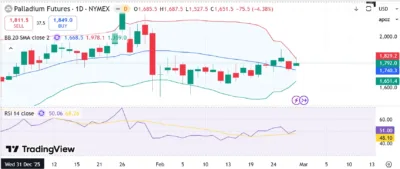
- Palladium futures remain under visible technical pressure on the daily timeframe after failing to sustain momentum above the 20-day moving average, with price currently hovering near $1,651 following a sharp 4.38% daily decline that reinforced short-term selling pressure.
- The Relative Strength Index (RSI 14) sits close to the neutral 50 midline, signaling balanced momentum rather than strong bullish or bearish dominance.
- A sustained breakout above the $1,740–$1,830 resistance corridor would be required to shift the broader structure back toward a constructive bullish outlook.
Palladium Futures on NYMEX continue consolidating within the lower half of the Bollinger Bands after an aggressive February breakdown that erased prior gains and established a sequence of lower highs, reflecting a shift from expansion to corrective consolidation. At the time of analysis, price remains positioned beneath the 20-day simple moving average near $1,740, while the upper Bollinger Band stands around $1,829 and the lower band aligns near $1,651, placing the metal at the lower volatility boundary following the recent sell-off.
The rejection from levels near $1,980 earlier in the cycle marked a significant structural turning point, triggering sustained downside pressure that forced price into the $1,600 demand region, where buyers are currently attempting to stabilize the market while preventing a deeper breakdown toward the recent swing low near $1,527.
Also Read: Pippin (PIPPIN) Price Prediction 2026–2030: Can PIPPIN Hit $0.70 Soon?
Market Sentiment and Momentum
Short-term sentiment reflects caution rather than panic, as the RSI hovering around 50 indicates that bearish momentum has slowed without yet transitioning into confirmed bullish strength, suggesting that market participants are reassessing positioning following the February drop.
While sellers successfully pushed price below the 20-day SMA, the inability to break convincingly beneath $1,600 indicates that downside follow-through remains limited for now. A daily close above $1,740 would likely confirm improving sentiment and increase the probability of a retest toward the $1,800–$1,830 resistance cluster.
Current Market Overview
The Bollinger Bands (20 SMA, 2 standard deviations) are beginning to contract after prior expansion, signaling reduced volatility and potential preparation for the next directional move. The upper band near $1,829 represents immediate dynamic resistance, the mid-band at $1,740 acts as structural pivot resistance, and the lower band near $1,651 reflects short-term support aligned with current trading levels.
We're back on X.
— 36Crypto (@36Crypto1) August 21, 2026
Our previous account (36crypto2) is currently unavailable while we continue working through the appeal process. In the meantime, this is our new official account. While you are on this page, please support us by sharing and following.
Price remaining below the mid-band confirms that broader pressure persists; however, sustained consolidation above $1,600 would preserve the possibility of gradual structural recovery and the formation of higher lows.
Technical Analysis
From a structural perspective, Palladium remains in a corrective phase following its failure to maintain positioning above $1,900 earlier in the year, with the large bearish candle in early February accelerating downside momentum and altering the medium-term trend profile.
Immediate support stands at $1,600, while stronger structural support rests near $1,527, which marks the recent swing low and serves as a critical defense level for buyers. A breakdown below $1,527 would significantly weaken the technical outlook and expose downside risk toward $1,450.
On the upside, resistance at $1,740 must be cleared first before price can challenge the $1,829 upper Bollinger boundary. A confirmed breakout above $1,830 would represent a structural shift capable of reopening the path toward $1,950–$2,000.
Source: Tradingview
Palladium Price Forecast (2026–2030)
| Year | Minimum Price | Average Price | Maximum Price | Potential ROI (From $1,651) |
| 2026 | $1,500 | $1,800 | $2,100 | +27% |
| 2027 | $1,700 | $2,200 | $2,600 | +57% |
| 2028 | $1,900 | $2,800 | $3,300 | +99% |
| 2029 | $2,200 | $3,400 | $4,000 | +142% |
| 2030 | $2,600 | $4,200 | $5,000 | +203% |
2026
In 2026, Palladium is expected to remain volatile while attempting to establish structural support above $1,500, with potential rallies toward the $1,800–$2,100 range if industrial demand strengthens and buyers successfully reclaim resistance above $1,740.
2027
If higher lows begin forming consistently and broader commodity markets recover, Palladium could extend gains toward $2,600 amid renewed institutional allocation into industrial metals.
2028
During stronger commodity expansion cycles, tightening supply conditions and demand recovery may push price toward $3,300 under favorable macroeconomic dynamics.
2029
Consolidation above $2,200 would support structural maturation, potentially allowing rallies toward $4,000 if global manufacturing and automotive demand accelerate.
2030
Long-term supply constraints combined with cyclical commodity expansions could position Palladium near $5,000 if bullish momentum sustains across multi-year market phases.
Conclusion
Palladium enters March consolidating near $1,651 following a sharp corrective phase that shifted short-term momentum neutral, with RSI stabilization near 50 and narrowing Bollinger Bands signaling reduced volatility ahead of a potential directional move. The $1,740–$1,830 resistance region remains decisive, and only a confirmed breakout above this zone would significantly strengthen the long-term outlook and increase the probability of a sustained recovery toward $2,000 and beyond.
FAQs
1. What is the current market sentiment for Palladium?
Current market sentiment for Palladium is neutral to cautiously bearish, as price continues trading below the 20-day SMA near $1,740 while the RSI holds around the 50 midline, reflecting balanced momentum without strong directional dominance from either buyers or sellers.
2. Is Palladium currently oversold on the daily timeframe?
No, Palladium is not technically oversold at this stage because the RSI remains near 50 rather than below 30, which indicates that selling pressure has slowed but has not reached exhaustion levels typically associated with deep oversold conditions.
3. What are the most important support levels to monitor?
The most immediate support level stands at $1,600, which buyers are currently defending, while stronger structural support is located near $1,527, representing the recent swing low that, if broken decisively, could expose further downside toward the $1,450 region.
4. What resistance levels must be reclaimed for a bullish shift?
Price must first close decisively above the $1,740 mid-Bollinger Band resistance before challenging the $1,829–$1,830 upper band zone, as a confirmed breakout above that range would signal renewed bullish momentum and increase the probability of a move toward $1,950 and potentially $2,000.
5. Can Palladium realistically reclaim $2,000 in the near term?
A recovery toward $2,000 remains possible, but it would require sustained bullish follow-through above $1,830, improved momentum readings on the RSI pushing toward 60–70, and continued defense of the $1,600 structural support to confirm that the corrective phase has ended.
Also Read: Enso (ENSO) Price Prediction 2026–2030: Can ENSO Hit $4.63 Soon?
