

London, United Kingdom, March 31, 2026
When Concordium’s leadership laid out the vision in Town Hall #1, the agentic economy was still a thesis, something the team projected would mature in late 2026 or early 2027. The market had other plans.
NVIDIA has sized the agentic AI opportunity at $1 trillion. Google launched AP2 with over 60 partners, including Mastercard, PayPal, and Visa. OpenAI and Stripe shipped an Agentic Commerce Protocol live inside ChatGPT checkout. MoonPay open-sourced an agent wallet layer. TRON expanded its AI fund to $1 billion. Projections now place the agentic economy at $30 trillion by 2030.
The speed at which agents went from concept to commercial infrastructure compressed Concordium’s timeline. What was planned for H2 2026 is happening now.
The Gap No One Else Is Filling
Every major chain is racing to build for agents. Ethereum’s ERC-8004 has logged over multiple thousands of agent registrations since January, with MetaMask, Google, and Coinbase involved — but identity remains optional code. Solana’s elizaOS ecosystem has 17,600 GitHub stars and commands 77% of x402 volume, but offers no identity layer and no compliance. Virtuals has launched over 17,000 agents generating $39.5 million in revenue, but with no human accountability. 0G raised $290 million, but has no identity infrastructure.
The pattern is clear: payment rails, wallets, discovery, and computation are table stakes. What no chain has is a mandatory, protocol-level, verified identity that links agents to accountable humans. Critically, this cannot be retrofitted. It has to be built from day one.
We're back on X.
— 36Crypto (@36Crypto1) August 21, 2026
Our previous account (36crypto2) is currently unavailable while we continue working through the appeal process. In the meantime, this is our new official account. While you are on this page, please support us by sharing and following.
Concordium has it. And that distinction of verified humans, verified agents, one protocol is precisely the gap that the rest of the market cannot close.
From Smart Money to the Trust Layer for Agents
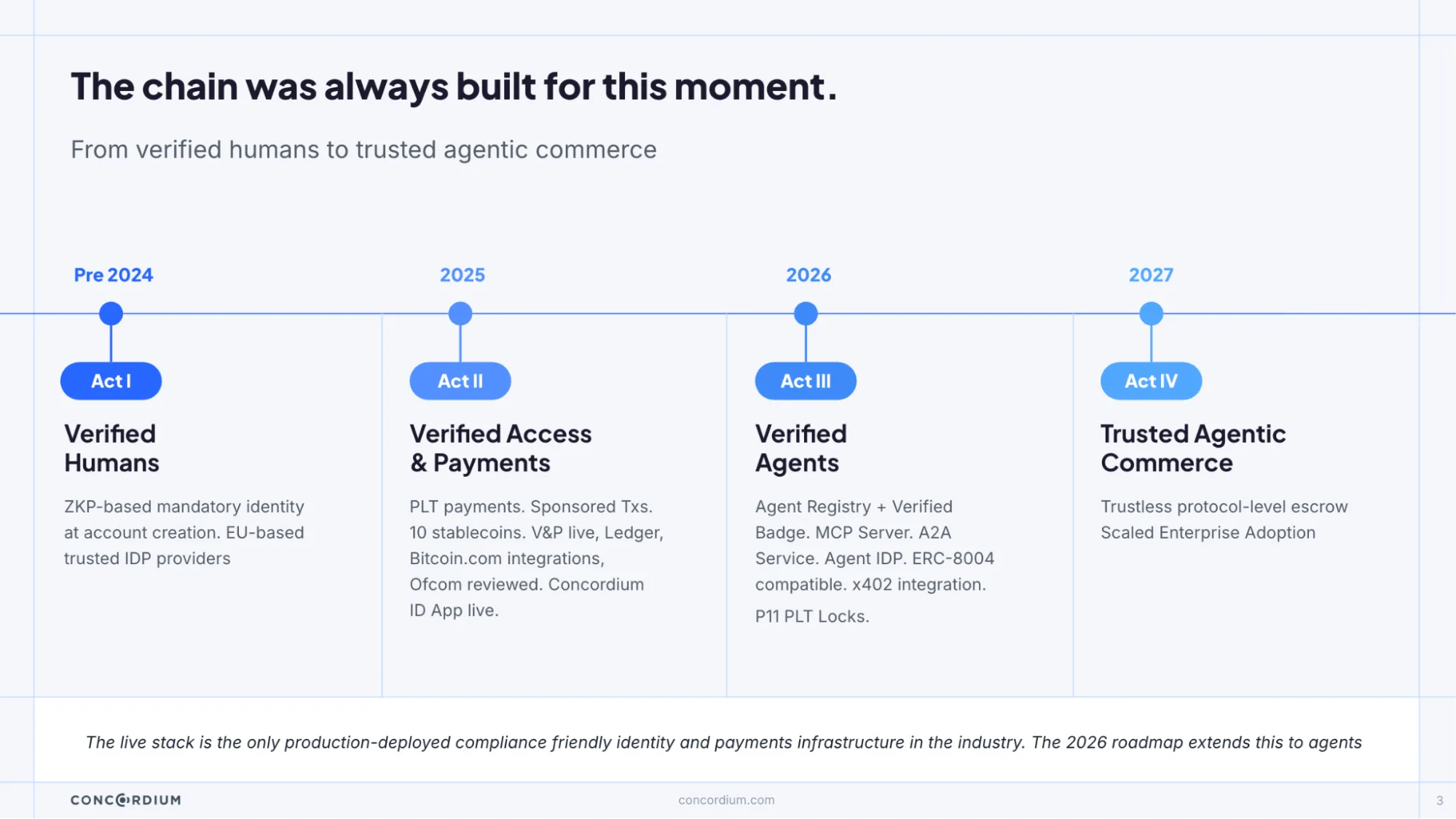
The progression was always by design. Pre-2024, Concordium built its human verification framework: trusted identity providers backed by a strong zero-knowledge proof architecture. In 2025, the team laid the foundations for verification at scale, and payments infrastructure: protocol-level stablecoins, Concordium ID live on iOS and Android, Verify & Pay, and real merchant integrations.
The x402 integration signed last year was not incidental. What changed is the timeline: with the agentic economy forming faster than projected, Concordium is activating now to onboard developers early and begin enterprise pilots in Q3, ahead of a larger-scale agentic commerce push in 2027.
Everything built over the past twelve months, like identity, stablecoins, and compliance-ready payments, now serves a dual purpose: infrastructure for verified humans and infrastructure for verified agents, unified under one protocol.
What’s Being Built: The Agentic Stack
On the technology side, the roadmap presented at Town Hall #5 is concrete and already in motion. Protocol-Level Identity for Agents – An on-chain Agent Registry serves as an identity anchor with verified badge support, compatible with ERC-8004.
An Agent IDP issues ZKP-verifiable credentials so agents can prove spending limits, jurisdictional permissions, and authorisation without exposing underlying data. The key distinction from every other chain: on Concordium, identity is enforced at account creation.
Protocol-Level Payments with Safeguards – Protocol-Level Locks arrive in two drops. The first introduces simple locks: PLTs held by the protocol rather than smart contracts, where an agent locks funds, and a counterparty delivers or funds auto-return.
Agent Discovery and Adoption – Concordium is building integration points across the major agent ecosystems. An A2A Agent Card makes Concordium discoverable on any registry with zero development effort from the counterparty.
An MCP Server exposes Concordium tools to Claude, GPT, LangChain, and Cursor for both read and write operations. Integrations with Fetch.ai, Virtuals, Olas, Naptha AI, and ElizaOS are in the pipeline.
Security – The whole chain has successfully undergone a security audit by one of the biggest names in the industry, CertiK. We’re going to be working with them on ensuring a safe, agentic future.
A Leaner, Sharper Organisation
This opportunity demanded a different kind of organisation. Over the past six weeks, Concordium has quietly restructured, focusing headcount on the critical path, with every role mapped directly to a deliverable on the roadmap.
And in a move that underscores commitment to the thesis, Concordium is becoming an agentic-first organisation internally. Code is already being written by agents. Marketing content is AI-driven. Sales workflows are agentic. Within three months, the organisation aims to be agentic-first.
A New Partnership
An announcement has made the Town Hall even more impressive. Revolut has bought into Concordium’s vision for the agentic economy. The first step: a CCD listing across 30+ markets wherever Revolut operates, giving 70 million consumers and over 500,000 businesses access to the token. The team is actively working toward execution.
Verified Humans. Verified Agents. One Protocol.
What Town Hall #5 made clear is that this is not a vision document. It is an execution plan backed by production infrastructure. Verified humans are already on-chain. Stablecoins are live. Real merchants are transacting. Regulators are reviewing. Over the next six months, all of it extends to AI agents.
No other chain can say that verified humans and verified AI agents operate on the same identity layer. Concordium was built for this moment — and built this way from the beginning. One protocol. One answer. The only one that counts.
About Concordium
Concordium is the trust infrastructure for agentic commerce. Its identity layer uses zero-knowledge proofs to verify users, businesses, and AI agents without exposing personal data. Products include Verify & Pay for ZKP-based identity and payments, and Agent Chain for verified AI agent identity and agentic payments. Concordium serves financial institutions, PSPs, and enterprises globally.
