
Key Takeaways
- A decentralized autonomous organization (DAO) is a blockchain-based organization governed by smart contracts instead of centralized leadership.
- DAO members use governance tokens to propose changes, vote on decisions, and influence the organization’s direction based on their holdings.
- Smart contracts automate operations, while cryptocurrencies reward participation and help align members with the organization’s goals.
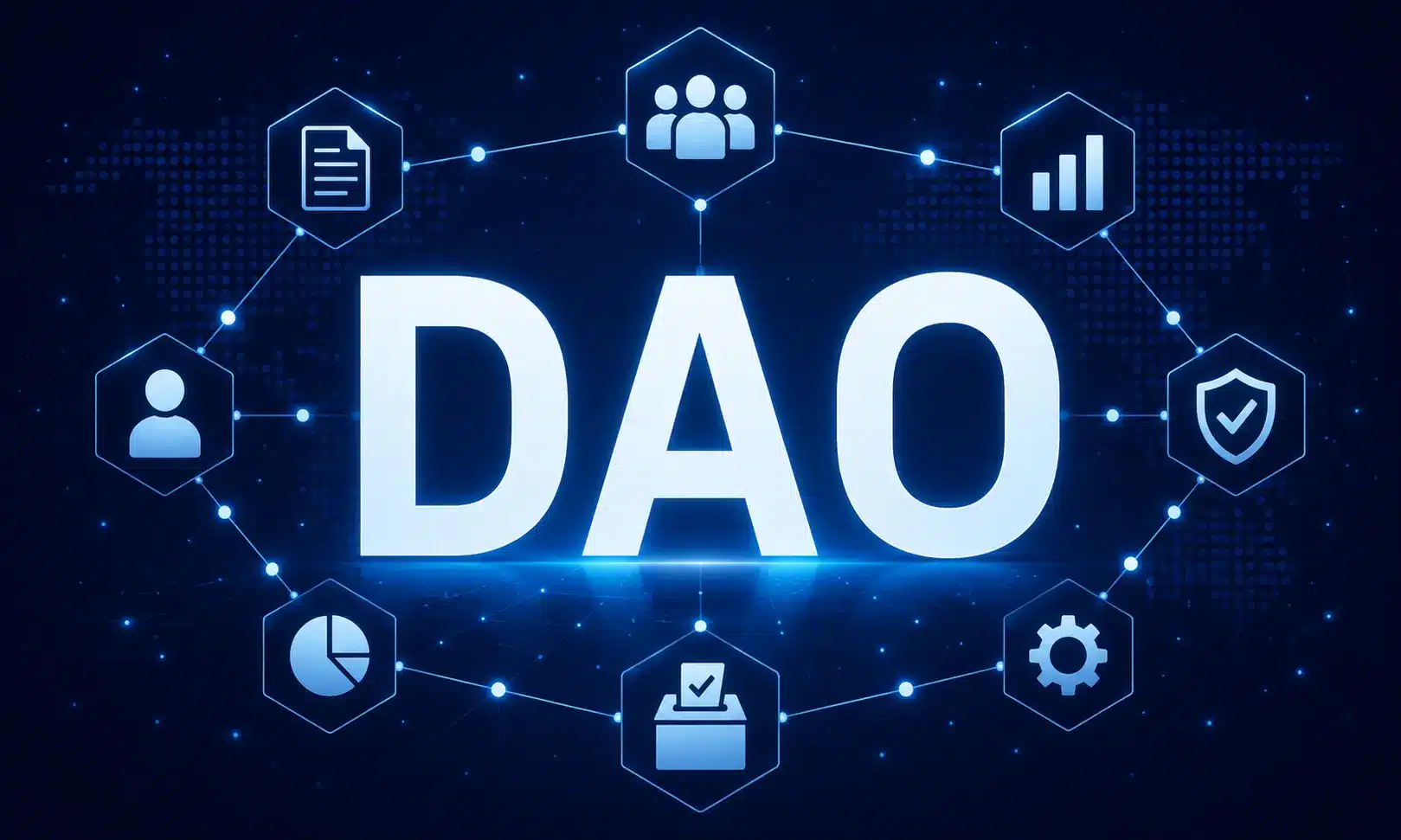
A decentralized autonomous organization (DAO) is one of blockchain technology’s most innovative governance models. Instead of relying on executives, boards of directors, or traditional management structures, DAOs allow communities to coordinate and make decisions collectively through blockchain technology.
Every rule governing a DAO is written into smart contracts, which automatically execute predefined instructions once specific conditions are met. This removes much of the need for intermediaries while creating a transparent system where decisions are recorded on a public blockchain.
Whether you are exploring decentralized finance (DeFi), blockchain governance, or cryptocurrency investing, understanding how DAOs work provides valuable insight into one of the technologies driving the decentralized economy.
Also Read: What Are Blockchain Consensus Mechanisms and How Do They Work?
What Is a Decentralized Autonomous Organization (DAO)?
A decentralized autonomous organization (DAO) is a blockchain-based organization that operates according to rules encoded in smart contracts. Rather than being managed by a central authority, a DAO distributes decision-making power among its members.
We're back on X.
— 36Crypto (@36Crypto1) August 21, 2026
Our previous account (36crypto2) is currently unavailable while we continue working through the appeal process. In the meantime, this is our new official account. While you are on this page, please support us by sharing and following.
Membership is typically obtained by holding the DAO’s governance token. These tokens represent ownership within the organization and give holders the right to vote on proposals, protocol upgrades, treasury spending, and other governance matters.
Unlike conventional organizations, where executives make strategic decisions, DAOs rely on community participation to determine how the organization evolves.
How Does a DAO Work?
A DAO functions through smart contracts deployed on a blockchain. These contracts define how proposals are submitted, how voting takes place, and what actions are automatically executed after community approval.
Members participate in governance by using their governance tokens to vote on proposals. In most DAOs, voting power corresponds to the number of tokens a member owns, meaning participants with larger stakes generally have greater influence over organizational decisions.
Once voting concludes and a proposal satisfies the required conditions, the smart contracts automatically implement the approved changes without requiring manual intervention.
What Are Governance Tokens?
Governance tokens are cryptocurrencies that give holders voting rights within a DAO. They represent both membership and participation in the organization’s governance process.
Because governance power is linked to token ownership, members are encouraged to make decisions that benefit the long-term success of the project. Many DAOs also reward active contributors with additional governance tokens, strengthening community participation and aligning incentives among members.
Some organizations also allow members to stake their governance tokens, demonstrating long-term commitment while unlocking additional governance privileges or ecosystem rewards.
Why Do DAOs Use Smart Contracts?
Smart contracts form the foundation of every DAO by replacing many administrative processes with automated code. Instead of relying on managers to approve transactions or enforce organizational rules, smart contracts execute instructions exactly as programmed.
This automation improves transparency because every rule and transaction is visible on the blockchain while reducing the need for trusted intermediaries. As a result, DAOs can continue operating efficiently even when members are located across different countries and time zones.
Examples of Popular DAOs
Several of the cryptocurrency industry’s largest projects operate using DAO governance models. MakerDAO manages the decentralized stablecoin DAI through its MKR governance token, allowing members to vote on protocol changes and risk management decisions.
Uniswap, one of the world’s largest decentralized exchanges, uses the UNI governance token to let its community influence the platform’s future development. Compound, a decentralized lending and borrowing protocol, relies on the COMP governance token to allow members to vote on upgrades and ecosystem proposals.
Another well-known example is ConstitutionDAO, a community-led initiative formed in 2021 that attempted to purchase a rare copy of the United States Constitution through collective fundraising.
Benefits and Potential Risks
DAOs offer several advantages over traditional organizations. Their governance systems are transparent, decisions are recorded permanently on the blockchain, and members from around the world can participate without centralized oversight.
Automated smart contracts also reduce administrative costs while enabling organizations to operate continuously without day-to-day management.
However, DAOs also face challenges, as governance may become concentrated if a small group controls a large percentage of governance tokens. Smart contract vulnerabilities can expose organizations to technical risks, while low voter participation may reduce the effectiveness of decentralized decision-making.
Each DAO therefore develops its own governance structure, voting requirements, and incentive mechanisms to balance decentralization with operational efficiency.
Conclusion
Decentralized autonomous organizations represent a new approach to organizing communities, businesses, and blockchain protocols. By combining smart contracts with governance tokens, DAOs enable members to collectively manage projects without relying on centralized leadership.
As blockchain adoption continues expanding, DAOs are expected to play an increasingly important role across decentralized finance, digital communities, and Web3 applications. Although governance and security challenges remain, DAOs continue demonstrating how blockchain technology can reshape organizational decision-making.
FAQs
1. What is a DAO?
A decentralized autonomous organization (DAO) is a blockchain-based organization governed by smart contracts, where members collectively make decisions using governance tokens instead of relying on centralized leadership.
2. How do people join a DAO?
Most DAOs allow users to become members by acquiring the project’s governance tokens, which provide voting rights and participation in governance decisions.
3. What are governance tokens?
Governance tokens are cryptocurrencies that allow holders to propose changes, vote on organizational decisions, and influence the future direction of a DAO.
4. Why are smart contracts important in a DAO?
Smart contracts automate governance rules and execute approved decisions without manual intervention, making DAO operations transparent, secure, and efficient.
5. What are some examples of DAOs?
Popular DAO-governed projects include MakerDAO, Uniswap, and Compound, while ConstitutionDAO became widely known for its community effort to purchase a rare copy of the U.S. Constitution.
Also Read: What Is the U.S. Strategic Bitcoin Reserve and How Does It Work?
