
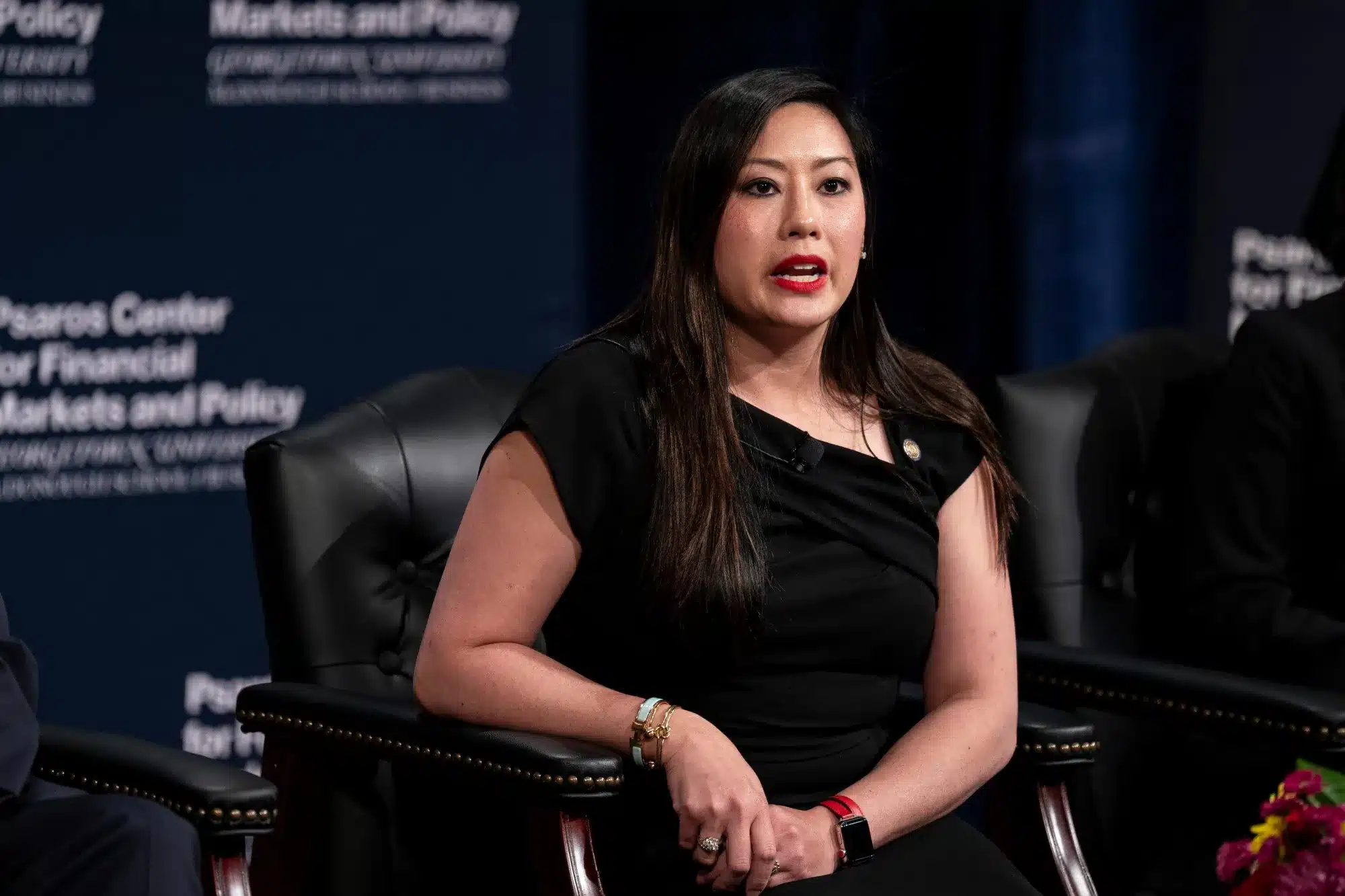
- SEC and CFTC agreement prompts Caroline Pham to reveal crypto reform roadmap
- Commissioner Pham outlines six regulatory changes aimed at strengthening crypto oversight
- New coordination between regulators signals a shift toward clearer United States crypto rules
Regulatory coordination in the United States entered a new stage after the SEC and CFTC signed a joint memorandum. The agreement strengthens cooperation between agencies responsible for supervising digital asset markets. Soon after the announcement, CFTC Commissioner Caroline Pham presented a policy roadmap addressing long-standing crypto regulation issues.
Pham, widely recognized for supporting clearer digital asset rules, explained her position through a public statement. According to Pham, regulatory uncertainty has continued to slow innovation across the American cryptocurrency sector. Developers and exchanges often struggle when launching products under unclear legal classifications.
Consequently, several blockchain companies consider operating outside the United States, where regulatory structures appear clearer. The memorandum, therefore, reflects an attempt to reduce regulatory overlap between the two agencies. Many market participants view the agreement as a step toward more coordinated oversight across the industry.
Also Read: Ripple $750 Million Buyback Plan: Will XRP Suffer? – Here’s What It Could Mean
SEC and CFTC Move Toward Closer Regulatory Cooperation
Industry observers say the memorandum may reduce conflicts between the two financial regulators. For years, companies faced uncertainty over whether certain digital assets qualified as securities or commodities. That regulatory tension created legal risks for businesses developing blockchain-based financial services.
Several crypto companies spent substantial resources defending themselves during regulatory disputes. The ongoing legal battles highlighted the consequences of unclear regulatory boundaries. Therefore, stronger coordination between the SEC and CFTC may reduce similar conflicts going forward.
Additionally, closer collaboration could simplify oversight of rapidly expanding digital asset markets. Both agencies supervise different aspects of financial markets that increasingly overlap within cryptocurrency ecosystems.
Caroline Pham Details Six Regulatory Reforms for Crypto Oversight
According to Pham, regulatory clarity should begin with stronger alignment between federal financial authorities. Her framework outlines six reforms designed to stabilize the digital asset regulatory environment.
The first proposal focuses on unified definitions for digital asset products across regulatory agencies. Regulators must determine whether tokens fall under securities law or commodities regulation. Clear classifications could reduce uncertainty affecting exchanges, developers, and institutional investors.
Another reform involves modernizing financial infrastructure rules governing clearing systems and collateral frameworks. Pham supports allowing stablecoins and tokenized assets to serve as collateral within financial markets. Such changes may improve capital efficiency for institutions participating in crypto trading environments.
She also advocates reducing compliance friction for licensed cryptocurrency exchanges operating within federal regulatory systems. A unified compliance framework could simplify operational requirements for registered trading platforms.
Streamlined Reporting and Coordinated Oversight Proposed
Pham’s plan also proposes standardized reporting systems across federal financial regulators, while unified reporting requirements could lower compliance costs for funds and trading firms. Standardization would also improve regulatory transparency and strengthen data consistency across markets.
Finally, Pham emphasized coordinated supervision between the SEC and CFTC, while joint monitoring could reduce duplicate investigations and improve enforcement consistency.
Such coordination may provide clearer regulatory signals to businesses operating within digital asset markets.
The SEC-CFTC memorandum signals an effort to stabilize regulatory oversight in the American crypto sector, while Pham’s six-point roadmap outlines how coordinated policies may shape the industry’s future.
Also Read: Bitcoin Enters ‘Most Frustrating’ Cycle Phase as Price Slips Below $70,000
