


- Massive SHIB inflows to exchanges signal rising sell pressure ahead
- Weak momentum and rising reserves keep SHIB trapped in downtrend
- Key support levels weaken as bearish structure continues dominating price action
Shiba Inu is experiencing heightened market pressure as a significant volume of tokens continues to move toward exchanges, raising concerns about the strength of its current price structure. Recent on-chain developments indicate that sellers are becoming more active, which is adding weight to an already fragile market environment.
Data shows that more than 160 billion SHIB tokens were transferred to exchanges within a single day, a movement that often reflects growing intent among holders to exit positions. As a result, this surge in exchange inflows has increased the available supply for trading, making it more difficult for buyers to sustain any upward movement in price. Consequently, even short-term stabilization attempts are facing resistance from continuous selling pressure.
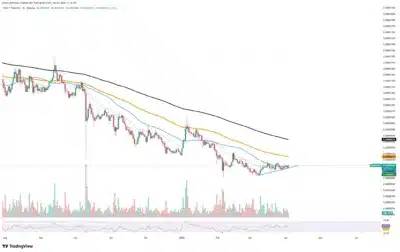
Price action further supports this outlook, as SHIB continues to struggle in maintaining a consistent upward trend despite forming a temporary rising structure. Although this short-term trendline exists, it lacks strong volume backing, which reduces confidence in its ability to hold.
Moreover, the broader technical pattern still reflects a sequence of lower highs, indicating that the prevailing trend remains tilted toward the downside. Therefore, recent price increases appear limited in strength and have not altered the overall bearish direction.
Exchange Supply Expansion Keeps SHIB Under Persistent Downward Pressure
The increase in exchange reserves is another factor contributing to the current outlook, as it signals a growing pool of tokens that can potentially be sold into the market.
We're back on X.
— 36Crypto (@36Crypto1) August 21, 2026
Our previous account (36crypto2) is currently unavailable while we continue working through the appeal process. In the meantime, this is our new official account. While you are on this page, please support us by sharing and following.
Additionally, this expanding supply continues to absorb incoming demand, which makes it increasingly difficult for SHIB to establish a sustained recovery phase. Hence, any upward movement is likely to face immediate resistance unless demand significantly improves.
From technical analysis, key resistance levels remain crucial in determining whether a reversal is possible in the near term. The immediate resistance zone lies between $0.0000065 and $0.0000067, where previous recovery attempts have consistently failed.
Source: Tradingview
Beyond that range, the $0.0000075 level aligns with a cluster of major moving averages, making it a stronger barrier that would need to be cleared for any meaningful trend shift. As such, failure to break these levels continues to reinforce the current bearish structure.
Weak Momentum Signals Reinforce Distribution Phase
On the downside, support remains between $0.0000055 and $0.0000057, although repeated testing has weakened its reliability over time. If this support zone breaks, lower demand levels could come into play, potentially extending the decline and increasing volatility across the market.
Momentum indicators also suggest limited strength, as there is no clear bullish divergence forming to support a reversal scenario. Furthermore, volume trends indicate a lack of accumulation, which implies that buyers are not stepping in aggressively. Instead, the current environment appears consistent with a distribution phase, where selling activity outweighs buying demand, shaping the market’s direction.
In conclusion, the movement of 160 billion SHIB into exchanges has intensified selling pressure and reinforced the existing bearish trend. Unless demand strengthens and key resistance levels are broken, the market is likely to remain under pressure, with risks tilted toward further downside or prolonged consolidation.
Also Read: XRP on the Brink: Analyst Predicts Massive Move Toward $8.30 Soon
