


In Brief:
- XRP faces resistance between $1.37 and $1.40 as tightening Bollinger Bands signal prolonged consolidation and limited immediate recovery potential.
- Ripple’s monthly escrow releases and restrictive Federal Reserve policies present challenges despite growing XRPL infrastructure and expanding stablecoin adoption.
- Stronger institutional demand, interest rate reductions, and expanded decentralized lending could support XRP’s recovery toward the psychological $2 level.
XRP faces a prolonged struggle to reclaim $2 as tightening technical indicators and persistent token supply limit its recovery prospects. The cryptocurrency trades near $1.31, with analysts examining whether current market conditions could delay a sustained breakout until 2028.
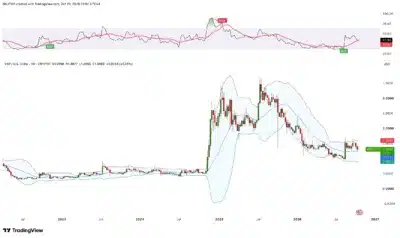
According to TradingView data, XRP’s weekly Bollinger Bands have narrowed considerably, reflecting reduced volatility and limited price movement across recent trading sessions. The token faces immediate resistance between $1.37 and $1.40, while its technical structure resembles the extended consolidation period between 2022 and 2024.
Meanwhile, the 20-week simple moving average stands at $1.2514, providing nearby support against further selling pressure. The upper Bollinger Band sits at $1.5997, establishing another technical level above the immediate resistance zone.
Prediction market Polymarket places XRP’s probability of reaching $2 during October at approximately 10%, reflecting limited expectations for an immediate recovery.
Source: TradingView
We're back on X.
— 36Crypto (@36Crypto1) August 21, 2026
Our previous account (36crypto2) is currently unavailable while we continue working through the appeal process. In the meantime, this is our new official account. While you are on this page, please support us by sharing and following.
Also Read: Stellar (XLM) Hosts First Regulated Treasury-Backed Repo Transaction With Under One Cent in Fees
Ripple Escrow Releases and Federal Reserve Policy Complicate XRP’s Recovery
Ripple’s monthly escrow releases remain an important consideration as XRP struggles to establish stronger buying momentum across cryptocurrency exchanges. The company unlocks up to one billion XRP monthly, typically returning a substantial portion to escrow.
Approximately 200 million to 300 million tokens may enter circulation through institutional transactions, depending on Ripple’s distribution activities. These releases create additional supply that market demand must absorb before sustained price appreciation becomes easier.
Meanwhile, restrictive Federal Reserve monetary policy has complicated conditions for risk assets, including cryptocurrencies, by maintaining competition from interest-bearing investments.
Despite these challenges, Ripple has expanded its payment infrastructure while the XRP Ledger develops additional financial applications. The RLUSD stablecoin and automated market maker functionality represent important components of the network’s broader institutional development.
Additionally, proposed lending functionality under XLS-66 could expand financial activity across XRPL, creating further opportunities for XRP utilization.
Institutional Demand and DeFi Expansion Could Influence XRP’s $2 Breakout
Several developments could change XRP’s current trading structure, particularly stronger institutional demand and reduced selling pressure across cryptocurrency markets.
Greater institutional purchases could absorb available OTC supply, potentially directing additional demand toward public exchanges and supporting higher prices. Federal Reserve interest rate reductions could also improve liquidity conditions and increase investor appetite for digital assets.
Besides institutional purchases, expanded lending applications could encourage XRP holders to allocate tokens toward decentralized financial services. Wider RLUSD adoption could increase transaction activity, although XRP transaction fees remain relatively small. XRP remains below its immediate resistance levels, with the $2 target dependent on stronger demand and improving market conditions.
Also Read: Vitalik Buterin Reveals Major Cost Difference Between Bitcoin Mining and AI Operations
