

Summary
-
Cardano’s two-hour chart confirms a bearish death cross as ADA trades near $0.248 following selling pressure and weakened market momentum.
-
ADA faces crucial support at $0.227 and $0.213, while resistance near $0.29 remains a major obstacle for potential recovery.
-
Cardano expands blockchain education and programmable token capabilities, while Midnight strengthens its Japanese market presence through another NIGHT exchange listing.
Cardano (ADA) has recorded a bearish death cross on its two-hour chart, raising concerns about the cryptocurrency’s short-term price direction. The technical development follows a period of selling pressure that pushed ADA below its recent highs.
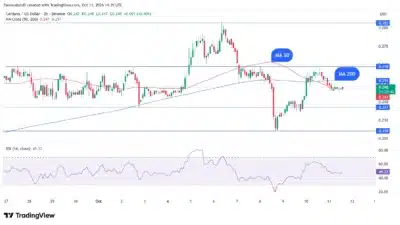
According to TradingView chart data, Cardano’s 50-period moving average crossed below its 200-period moving average, confirming the bearish formation. Traders generally interpret this pattern as a sign of weakening momentum, particularly when prices struggle to recover.
ADA recently climbed to $0.283 before sellers pushed the cryptocurrency down to $0.224 across three consecutive trading sessions. Buyers subsequently supported a recovery toward $0.259, but the rebound failed to establish sustained upward momentum.
At reporting time, Cardano traded around $0.248, representing a 2.74% decline over 24 hours and a 0.8% weekly loss. This performance places additional attention on nearby support levels as traders assess whether selling pressure could intensify.
Also Read: Hoskinson Teases Cardano Leios Upgrade as ADA Gains 12% to Five Month High
Cardano Death Cross Places $0.227 Support Under Pressure as Sellers Maintain Control
The bearish crossover has brought Cardano’s immediate support levels into consideration, with $0.227 emerging as an important price area. A sustained decline below this level could expose the next support zone around $0.213.
We're back on X.
— 36Crypto (@36Crypto1) August 21, 2026
Our previous account (36crypto2) is currently unavailable while we continue working through the appeal process. In the meantime, this is our new official account. While you are on this page, please support us by sharing and following.
Meanwhile, resistance remains near $0.29, where ADA encountered selling pressure during its October 6 trading session. Reclaiming this level would require stronger buying activity and a recovery from the recent downward price movement.
Significantly, the death cross reflects previous price weakness rather than providing confirmation of another decline. Moving averages respond to historical market movements, meaning their crossovers can sometimes produce misleading signals during periods of consolidation.
Source: TradingView
For this reason, trading volume and price behavior around established support levels remain important measures of Cardano’s short-term direction. Increased buying activity could weaken the bearish setup, particularly if ADA moves above its relevant moving averages.
Cardano Ecosystem Developments Advance Despite Bearish Price Structure
Beyond the technical developments, the Cardano Foundation has announced its participation in the University of Nicosia’s Blockchain and Digital Assets course. The foundation will teach Cardano fundamentals while sponsoring 25 places within the program’s Advanced Track.
Additionally, programmable tokens have reached Cardano’s mainnet, with wallet providers, blockchain explorers, and development teams supporting the CIP-0113 standard. This development expands the network’s technical capabilities while ADA navigates a challenging trading environment.
Midnight’s NIGHT token will also become available on OKCoin Japan beginning October 13, following its earlier listing on S.BLOX. The additional exchange listing expands access to Midnight’s privacy-oriented blockchain ecosystem within the Japanese market.
For ADA, the immediate technical outlook remains tied to its ability to defend $0.227 and recover toward established resistance. The two-hour death cross signals weaker momentum, while subsequent price movements will determine whether the bearish formation gains confirmation.
Also Read: XRP Ledger Prepares Major Protocol Fixes as October 23 Activation Approaches
