

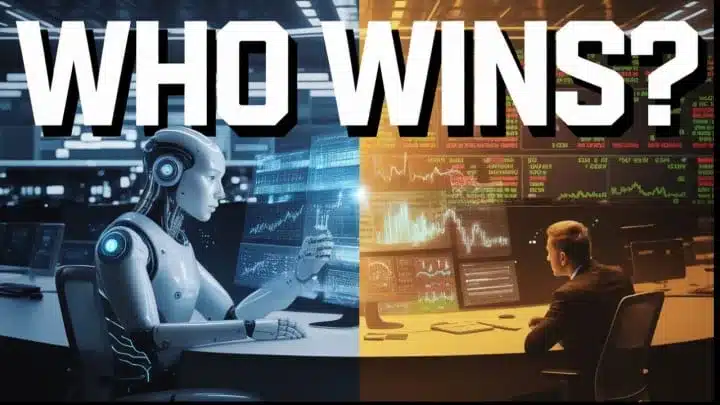
The crypto market in 2026 looks nothing like it did five years ago. Institutional capital has flooded in, regulatory frameworks have matured across major economies, and perhaps most consequentially, artificial intelligence has become a permanent fixture on trading desks.
Algorithms now account for a significant share of daily crypto volume. The question traders and analysts are wrestling with is straightforward: when it comes to returns, are AI systems beating the humans?
The short answer is: it depends on the market. The longer answer reveals something more nuanced about where machine intelligence excels and where human judgment still holds an edge.
Speed and data processing: AI’s clearest advantage
AI trading systems were built for exactly the kind of environment crypto markets create. Prices shift in milliseconds. Sentiment swings on a single post. Liquidity can evaporate before a human can react. In this terrain, AI bots operating on high-frequency and algorithmic strategies have a structural advantage that human traders simply cannot replicate.
In 2026, top-tier AI trading systems process on-chain data, order book depth, derivatives positioning, and social sentiment simultaneously. They execute dozens of trades per second, maintain emotionless discipline during drawdowns, and recalibrate strategies in real time. Retail and even professional human traders cannot match this on pure execution speed alone.
Studies tracking bot performance against human traders in 2025 and early 2026 have consistently shown that AI systems outperform humans in ranging or mildly trending markets where pattern repetition is high. This comparison has been well-documented, and a closer look at how AI bots stack up against human traders across digital asset markets makes clear that the gap is growing as models become more sophisticated.
Where humans still win
We're back on X.
— 36Crypto (@36Crypto1) August 21, 2026
Our previous account (36crypto2) is currently unavailable while we continue working through the appeal process. In the meantime, this is our new official account. While you are on this page, please support us by sharing and following.
Despite these advantages, experienced human traders have outperformed AI systems in one crucial scenario: periods of structural market disruption. When something genuinely unprecedented happens, AI models trained on historical data can misread the signal entirely.
The early 2026 macro shocks brought this into focus. When a cluster of geopolitical events triggered a sharp correlation breakdown between Bitcoin and traditional risk assets, several AI systems continued executing strategies calibrated for an older regime. Human traders who understood the macro context reduced exposure faster and re-entered at better prices.
This is the core limitation of even the most advanced trading AI in 2026: it learns from what has happened. It cannot reason about what has never happened before in quite the way a well-informed human can. Context, narrative, and macro intuition remain human strengths.
Experienced traders also maintain an edge in illiquid altcoin markets. Many smaller tokens have thin order books and low data availability. AI systems lack the training data to model these markets reliably, and their own execution can move prices against their positions. Here, human traders who have developed market intuition over the years often generate superior risk-adjusted returns.
The numbers in 2026
Return figures vary widely depending on strategy type and market conditions, but some patterns are clear from available data this year.
AI-driven quantitative funds running crypto-specific strategies have reported consistent monthly returns in the 3 to 7 percent range during stable trending periods, with drawdowns kept tight through automated risk controls. The best human traders running discretionary macro strategies have posted comparable or higher returns during volatile periods, but with far greater variance.
Retail AI tools have democratised access to algorithmic strategies for everyday investors. Platforms offering pre-built AI trading bots saw user numbers double between 2024 and 2026. Average returns for retail users of these tools have outpaced buy-and-hold strategies in sideways markets, though results remain highly dependent on the underlying model quality and risk settings.
Professional human traders operating at hedge funds or proprietary desks have, on average, matched or slightly underperformed AI-driven peers on a risk-adjusted basis in 2026. The gap, however, narrows significantly when human traders work alongside AI tools rather than against them.
The hybrid model is winning
The most profitable trading operations in 2026 are not purely AI-driven, nor are they purely discretionary. They are hybrid. AI handles execution, risk management, and pattern recognition at scale. Humans set strategic direction, interpret macroeconomic signals, and override systems when the market is behaving in ways the model has not seen before.
Several crypto hedge funds that adopted this model in 2024 reported their best performance in 2025 and continued that trajectory into 2026. The human-AI collaboration functions as a division of labour: machine precision applied to known patterns, human judgment applied to novel ones.
This dynamic is visible in how leading trading desks are structured today. Fewer pure discretionary traders exist at the senior level. Instead, portfolio managers work directly with quant teams to tune AI systems and define override conditions. The trader who understands both markets and machine learning is now the most valuable person in the room.
What this means for individual investors
For retail participants asking whether they should use AI tools or rely on their own analysis, the evidence in 2026 points in a clear direction. In liquid, data-rich markets trading major tokens like Bitcoin and Ethereum, AI tools offer a tangible edge for systematic strategies. Attempting to out-trade algorithms on short timeframes through manual execution is increasingly unrewarding.
Where individual investors can still add value is in research, thesis-building, and identifying early-stage opportunities in smaller markets before institutional capital and AI systems arrive. These areas require qualitative judgment, network intelligence, and risk tolerance that algorithms are poorly equipped to replicate.
The verdict
AI is making more money than most human traders in 2026, particularly in systematic, high-frequency, and risk-managed strategies across major crypto pairs. But the most profitable players in the market are not choosing between AI and human judgment. They are combining both. The future of crypto trading belongs to those who understand how to work with intelligent systems, not those who insist on working without them.
With crypto markets leaning toward extreme volatility, tighter spreads, and 24/7 algorithm competition, traders who will pair AI execution with human expertise have a better chance to gain the most while also managing the drawdowns.
