


What to Know
- Bitcoin’s realized volatility dropped to 17%, marking multi-year lows.
- Bitcoin remains below its 200-day average despite recent recovery.
- Analyst Axel Adler Jr. says volatility compression often precedes major moves.
Bitcoin’s one-week realized volatility has dropped to approximately 17%, placing the market among its calmest trading periods in years. According to CryptoQuant analyst Axel Adler Jr., the unusually low reading signals that Bitcoin may be approaching a major directional move as price continues trading below its 200-day moving average.
Realized volatility measures actual price movement rather than future expectations. Adler noted that the metric has declined roughly 56% from nearly 39% recorded at the beginning of the quarter. Moreover, the current reading sits well below the long-term median of around 34%, highlighting a market that has largely stopped trending and entered a period of consolidation.
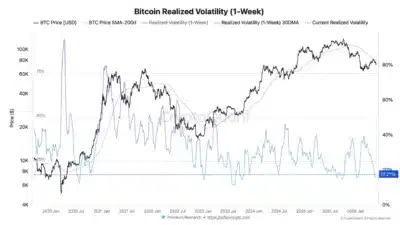
The latest chart shared by Adler shows that current volatility levels stand near the lowest readings observed throughout the current market cycle. Consequently, traders are paying closer attention to the possibility of a significant breakout or breakdown in the coming weeks.
Also Read: Binance Launches 7,000 U.S. Stocks as Tokenized Trading Plans Advance
Bitcoin Volatility Compression Signals Market Tension
According to Adler, periods of deep volatility compression rarely persist for extended periods. Instead, they often appear before major directional moves as market pressure gradually builds beneath the surface. Data accompanying the analysis shows that previous stress events pushed one-week realized volatility above 90%. However, current levels remain close to the opposite extreme. As a result, the analyst believes the market is entering a critical phase where volatility could soon begin expanding again.
Historical patterns visible on the chart support that observation. Similar volatility contractions appeared before major Bitcoin advances and corrections in previous market cycles. Although historical trends do not guarantee future performance, they continue providing valuable context for current market conditions.
We're back on X.
— 36Crypto (@36Crypto1) August 21, 2026
Our previous account (36crypto2) is currently unavailable while we continue working through the appeal process. In the meantime, this is our new official account. While you are on this page, please support us by sharing and following.
Source: CryptoQuant
At the same time, Bitcoin continues trading below its 200-day simple moving average, a technical indicator closely watched by investors and traders. While the cryptocurrency has recovered from recent lows, it has not yet reclaimed this important trend level. The chart shows Bitcoin trading around the $80,000 region while the 200-day moving average remains above current prices. Consequently, the market has yet to confirm a return to a stronger long-term uptrend.
Many analysts view the 200-day moving average as a dividing line between bullish and bearish market conditions. Therefore, Bitcoin’s ability to reclaim that level could play a major role in determining the next phase of price action.
Analyst Outlines Bullish and Bearish Scenarios
Adler explained that volatility expansion will likely determine the market’s next direction. If Bitcoin moves above the 200-day moving average while volatility increases, the development could support a broader recovery and renewed bullish momentum. However, the analyst also warned of a downside scenario. A volatility spike while Bitcoin remains trapped below the 200-day average could indicate increasing selling pressure and a potential risk-off move.
Besides the declining volatility, the chart highlights how subdued Bitcoin’s price action has become compared to previous years. During both the 2020 crash and subsequent bull market, volatility frequently exceeded 50% and occasionally surpassed 90%. In conclusion, Bitcoin remains caught between historically low volatility and a key technical resistance level. According to Adler, that combination suggests the market is building energy for a significant move, with the eventual direction likely becoming clearer once volatility begins expanding again.
Also Read: Here’s What XRP and XLM Holders Miss About DTCC’s Tokenization Service: Analyst Explains
