

Key Takeaways:
- SEC crypto regulation applies to securities, while CFTC crypto regulation oversees commodity derivatives, creating distinct responsibilities for cryptocurrency regulators nationwide.
- Bitcoin is generally treated as a commodity under CFTC oversight, while XRP’s legal status depends on how individual transactions occur.
- Proposed legislation, including the CLARITY Act, seeks clearer regulatory boundaries, reducing uncertainty for investors, blockchain companies, and cryptocurrency exchanges alike.
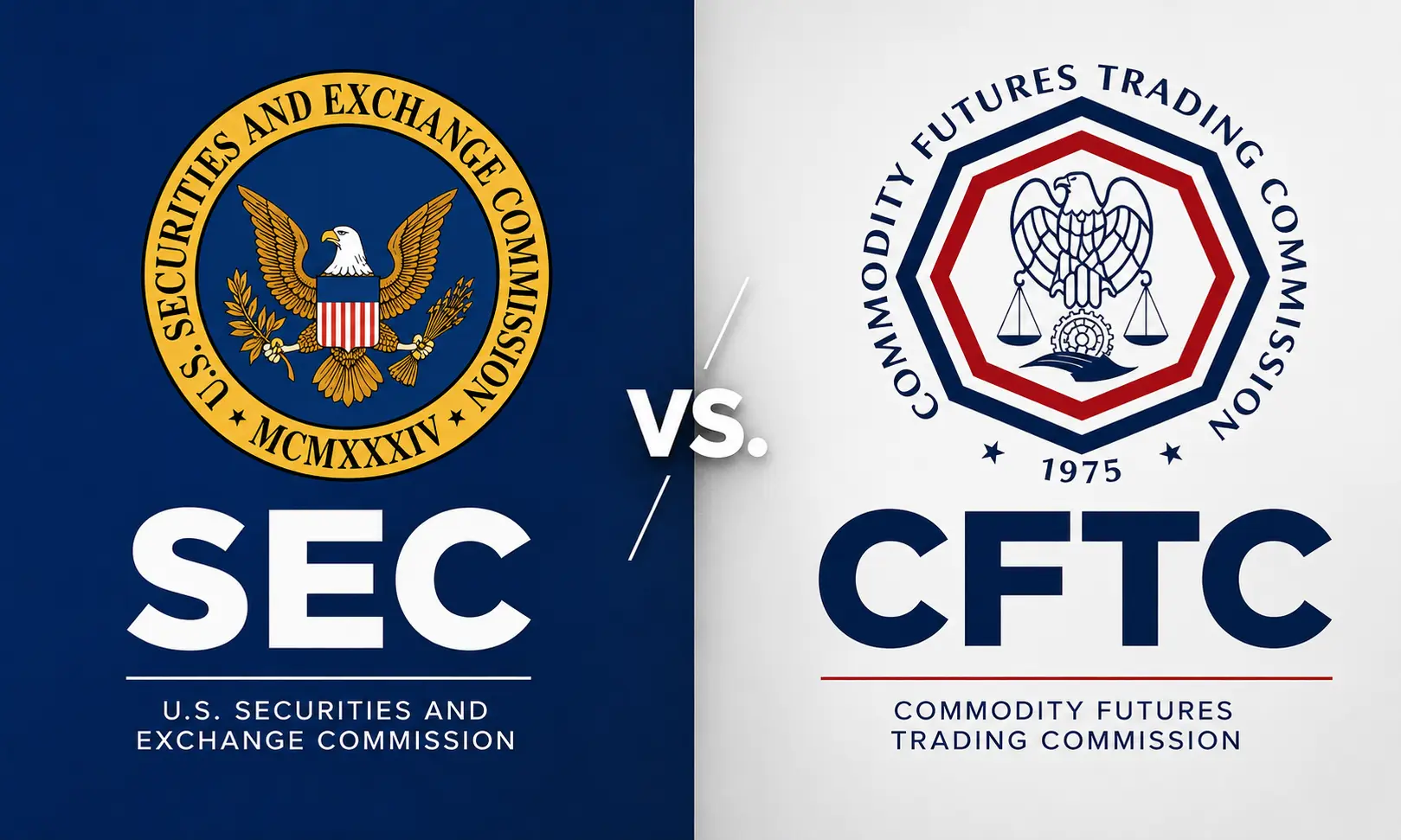
SEC crypto regulation and CFTC crypto regulation form the backbone of cryptocurrency oversight in the United States. Instead of relying on a single regulator, the country divides responsibility between two federal agencies based on whether a digital asset qualifies as a security or a commodity. This distinction affects everything from token launches and exchange operations to investor protections and compliance requirements.
As the cryptocurrency market has expanded, determining which agency has authority over a digital asset has become one of the industry’s biggest legal challenges. Court rulings, regulatory guidance, and proposed legislation continue to shape how cryptocurrency regulators oversee blockchain projects and digital assets.
Why Cryptocurrency Has Two Primary Regulators
Traditional U.S. financial laws were written decades before blockchain technology emerged, making it difficult to classify digital assets using existing legal frameworks. Some cryptocurrencies are designed primarily for fundraising, while others function as decentralized payment systems or utility tokens.
The SEC oversees securities markets and enforces rules designed to protect investors through registration and disclosure requirements. Meanwhile, CFTC crypto regulation focuses on commodity derivatives, including futures, options, and swaps, while also investigating fraud and manipulation involving commodities.
Because cryptocurrencies can evolve, a token’s regulatory classification may depend on how it is issued, marketed, and used rather than on the asset alone.
We're back on X.
— 36Crypto (@36Crypto1) August 21, 2026
Our previous account (36crypto2) is currently unavailable while we continue working through the appeal process. In the meantime, this is our new official account. While you are on this page, please support us by sharing and following.
Also Read: DeFi vs. CeFi: Transforming Financial Systems
How SEC Crypto Regulation Applies to Digital Assets
A major component of SEC crypto regulation is the Howey Test, a legal standard used to determine whether an asset qualifies as an investment contract. Under this test, an asset may be considered a security if investors contribute money with the expectation of earning profits from the efforts of another party.
Many blockchain projects have raised capital by selling tokens before launching their networks, prompting the SEC to argue that these offerings resemble traditional securities sales. Projects classified as securities generally must comply with registration requirements and investor disclosure rules.
While the SEC has historically relied on enforcement actions, its recent approach has placed greater emphasis on providing clearer guidance for the digital asset industry.
How CFTC Crypto Regulation Differs
Unlike the SEC, the Commodity Futures Trading Commission primarily regulates markets built around commodities and their derivatives. CFTC crypto regulation covers products such as Bitcoin futures and Ether futures traded on regulated U.S. exchanges.
The agency has consistently recognized Bitcoin as a commodity because it has no central issuer and derives its value from open market activity rather than the efforts of a single organization. Ether has also been widely treated as a commodity despite ongoing discussions surrounding its regulatory history.
Although the CFTC can pursue fraud and manipulation cases involving cryptocurrencies, it has limited authority over the day-to-day regulation of spot cryptocurrency markets.
Is Bitcoin Regulated by the SEC or CFTC?
One of the most common questions among crypto investors is, “Is Bitcoin regulated by the SEC or CFTC?” Bitcoin is widely recognized as a commodity under U.S. law. Since no company controls the Bitcoin network or promises profits to investors, regulators have consistently declined to classify it as a security.
As a result, the CFTC oversees Bitcoin derivatives markets, while the SEC regulates investment products tied to Bitcoin without treating the cryptocurrency itself as a security.
Is XRP a Security or a Commodity?
Another frequently asked question is, “Is XRP a security or a commodity?”
XRP occupies a unique position following the Ripple lawsuit. A federal court ruled that XRP sales on public cryptocurrency exchanges are generally not securities transactions, while certain institutional sales made directly by Ripple qualified as securities offerings.
The decision established that the legal treatment of a cryptocurrency can depend on the specific transaction rather than the digital asset itself, making XRP one of the most closely watched regulatory cases in the industry.
What Could Change U.S. Crypto Regulation?
Congress is considering legislation aimed at creating a clearer regulatory framework for digital assets. One of the most notable proposals is the CLARITY Act, which seeks to define when cryptocurrencies fall under SEC jurisdiction and when they should be regulated by the CFTC.
If enacted, the legislation could reduce regulatory uncertainty, establish clearer compliance standards, and encourage broader institutional participation in the cryptocurrency market.
Conclusion
SEC crypto regulation and CFTC crypto regulation remain central to the U.S. cryptocurrency industry. While the SEC focuses on securities and investor protection, the CFTC oversees commodity derivatives and monitors fraud involving commodities. As digital assets continue to mature, clearer legislation and regulatory guidance will play an important role in supporting innovation while maintaining market integrity.
FAQs
1. What is the difference between SEC crypto regulation and CFTC crypto regulation?
The SEC regulates securities, while the CFTC oversees commodities and cryptocurrency derivatives.
2. Is Bitcoin regulated by the SEC or CFTC?
Bitcoin is generally regulated as a commodity, placing its derivatives under the CFTC rather than the SEC.
3. Is XRP a security or a commodity?
XRP’s legal status depends on the type of transaction, with public exchange sales generally not treated as securities transactions as per the ruling in 2025.
4. Why are there two cryptocurrency regulators in the United States?
The SEC and CFTC have different legal responsibilities based on whether a digital asset is classified as a security or a commodity.
5. Will U.S. cryptocurrency regulation change in the future?
Proposed legislation, such as the CLARITY Act, could establish clearer boundaries between SEC and CFTC oversight of digital assets.
Also Read: USDT vs USDC: Understanding the Differences Between the Two Largest Stablecoins
