


What to Know:
- Strategy realized a 20% Bitcoin loss while retaining 843,775 BTC, highlighting differences between corporate holdings and exchange reserves.
- Darkfost said Binance’s realized price near $60,900 keeps its Bitcoin reserves closer to market breakeven than Strategy’s average cost basis.
- CryptoQuant data showed Binance controls nearly 30% of exchange Bitcoin reserves, as Strategy sold coins to fund dividend obligations instead.
CryptoQuant analyst Darkfost says Strategy’s latest Bitcoin sale has exposed a significant difference between the company’s acquisition cost and Binance’s reserve valuation. Although Strategy remains the largest known corporate Bitcoin holder, the analyst noted that Binance’s Bitcoin reserves sit much closer to the current market price.
According to Darkfost, Strategy sold 3,588 BTC for approximately $216 million during the week. The analyst said the company acquired those coins at an average price of $75,476 before selling them near the $60,000 level. Consequently, the transaction resulted in an estimated loss of around 20%.
Despite recording the loss, Strategy still owns 843,775 BTC, a figure that exceeds Binance’s reserve of 656,561 BTC, reinforcing the company’s position as the largest institutional Bitcoin holder.
Binance’s Lower Cost Basis Reflects Different Market Position
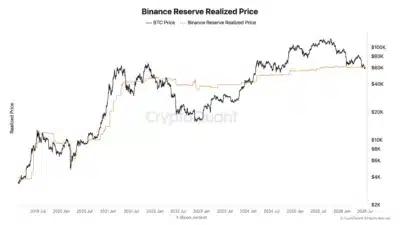
According to Darkfost, the comparison becomes more meaningful when average acquisition prices are considered instead of total holdings. CryptoQuant data estimates Binance’s reserve realized price at approximately $60,900, considerably lower than Strategy’s reported average purchase price.
The realized price represents the average acquisition cost of Bitcoin currently held in Binance’s wallets. Moreover, Bitcoin has traded around the same price range in recent sessions, placing much of Binance’s reserve close to breakeven.
We're back on X.
— 36Crypto (@36Crypto1) August 21, 2026
Our previous account (36crypto2) is currently unavailable while we continue working through the appeal process. In the meantime, this is our new official account. While you are on this page, please support us by sharing and following.
Also Read: UK Lawmakers Seek Permanent Ban on Crypto Political Donations Amid Farage Scrutiny
Source: CryptoQuant
CryptoQuant data also shows that Binance controls nearly 29.75% of Bitcoin held across centralized exchanges. Meanwhile, Bitfinex accounts for 16.75%, while Gemini and Kraken hold 8.66% and 8.46%, respectively. Darkfost added that centralized exchanges collectively custody around 8 million BTC, making Binance the dominant exchange by reserve size.
However, the analyst stressed that Strategy and Binance manage Bitcoin for entirely different purposes. The company treats Bitcoin as a long-term treasury asset, while Binance primarily holds customer deposits and provides liquidity for trading activity.
Why Binance’s Cost Basis Matters
Darkfost also explained that Strategy’s sale reflected liquidity requirements rather than a bearish view of Bitcoin. According to the analyst, the company used the proceeds to finance dividend payments linked to its Digital Credit securities instead of reducing exposure because of changing market expectations.
Additionally, Binance’s realized price has become an important on-chain indicator because it reflects the average cost basis of Bitcoin held on the exchange. When Bitcoin trades above that level, exchange-held coins generally remain in unrealized profit. Conversely, sustained trading below the realized price could increase selling pressure as more holders move into losses.
Darkfost’s analysis shows that Bitcoin ownership alone does not determine market strength. While Strategy holds more Bitcoin than Binance, the exchange’s lower realized price places its reserves much closer to the current market level, making its cost basis a closely watched metric as Bitcoin continues to trade near the $60,000 range.
Also Read: Analyst Reveals XRP Path to $15 as Critical Support Keeps Bull Case Alive Ahead
