


What to Know
- Whale orders and growing ETF holdings strengthen Bitcoin’s market structure, although spot demand must overcome the $83,000 resistance zone decisively.
- Binance reserves and positive exchange netflows increase available selling supply, forcing institutional buyers to absorb more Bitcoin before confirmation arrives.
- Falling open interest eased leverage risks, but profitable short-term holders and older coins could create renewed selling pressure near resistance.
Bitcoin’s spot market is attracting larger orders as institutional investors and whales increase their exposure near important resistance levels. However, rising exchange inflows show that buyers must absorb substantial supply before Bitcoin (BTC) confirms a sustainable breakout.
According to CryptoQuant analyst XWIN Japan, Bitcoin’s market structure has improved, although spot demand still requires stronger confirmation. The analyst identified the $82,000 to $83,000 range as the main barrier separating recovery from a decisive breakout.
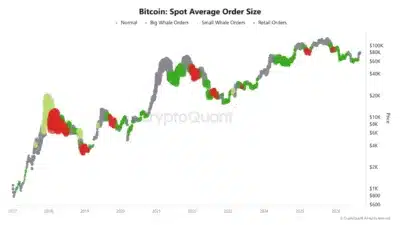
CryptoQuant’s Spot Average Order Size chart supports the broader argument surrounding growing participation from large investors. Green sections represent whale orders, while red sections track retail orders and grey areas show normal transaction sizes.
Recent chart activity contains several green clusters around Bitcoin’s recovery zone, indicating that large orders have influenced spot-market trading. Moreover, retail orders have not dominated the rebound, reducing signs of widespread speculative enthusiasm among smaller investors.
This distinction matters because whale participation can provide stronger support when large buyers accumulate rather than pursue leveraged positions. However, average order size does not reveal whether every transaction represents a purchase or sale.
XWIN Japan also highlighted a noticeable buy wall around current price levels, suggesting large investors are defending the market. Additionally, rising Bitcoin ETF holdings show that institutional products are gradually absorbing coins from the available supply.
We're back on X.
— 36Crypto (@36Crypto1) August 21, 2026
Our previous account (36crypto2) is currently unavailable while we continue working through the appeal process. In the meantime, this is our new official account. While you are on this page, please support us by sharing and following.
ETF accumulation carries particular importance because spot-backed products create direct demand without relying entirely on futures leverage. Consequently, persistent institutional inflows could help Bitcoin challenge resistance if exchange selling remains controlled.
Also Read: XRP Healthcare Takes XRPH Wallet Offline as Breach Affects 4,011 Users
Rising Exchange Supply Tests Institutional and Whale Buying Strength
Despite stronger whale participation, Binance holds approximately 685,000 to 687,000 BTC within its reserves. Those holdings represent considerable tradable supply, although high reserves do not automatically indicate immediate selling.
Meanwhile, seven-day average exchange net inflows have increased to approximately 593 BTC. Positive net inflows mean exchanges are receiving more Bitcoin than users are withdrawing.
Therefore, buyers must absorb existing reserves and incoming deposits before establishing stronger control above resistance. Increasing stablecoin inflows provide purchasing power, but they also create a two-sided market structure.
Source: CryptoQuant
Traders can deploy those stablecoins into Bitcoin, strengthening demand during a breakout attempt. Nevertheless, they may keep the funds inactive while waiting for clearer price direction.
Derivatives conditions have improved following a reduction in marketwide open interest. Open interest fell from approximately $27.5 billion to $25.7 billion between September 4 and September 5. Negative funding also showed that perpetual futures traders had become less aggressively bullish. Hence, the reset removed some leverage that could have produced cascading long liquidations.
Still, Binance Bitcoin open interest recently exceeded $10 billion, reaching its highest level in six months. That increase suggests derivatives remain influential, preventing analysts from classifying the recovery as fully spot-led.
Profitable Holders and Dormant Bitcoin Add Selling Risks
Short-term holder SOPR has moved above one, indicating that recently acquired coins are being spent profitably. This development reflects improving sentiment, although profitable holders could sell around the $82,000 to $83,000 resistance range.
Furthermore, older Bitcoin holdings have become more active, including coins associated with miners from 2010. Their movement does not confirm selling unless those assets reach exchanges, but it introduces another potential source of supply.
Bitcoin requires sustained spot volume, steady ETF accumulation, controlled leverage and weaker exchange inflows to validate a breakout. A firm move above $83,000 would strengthen the bullish structure, while repeated rejection could expose lower support levels.
Also Read: Solana Transaction Expansion Opens Door to ZK Rollups and Complex Applications
