


What to Know
- Bitcoin remains near $63,000 as supportive inflation data fails to overcome weak spot demand and subdued ETF buying from investors.
- Coinbase Premium Index remains near negative 0.1%, signaling limited United States buying pressure while leveraged futures positioning remains relatively heavy.
- Bitcoin faces resistance near $68,700, where short-term holders may sell, while stronger ETF inflows could improve underlying market demand.
Bitcoin is struggling to attract strong United States buying demand, keeping its price within the $63,000 to $64,000 range. Supportive inflation data has failed to produce a meaningful recovery, despite stronger reactions across traditional risk markets.
According to CryptoQuant analyst XWIN Japan, subdued spot activity remains a major factor restricting Bitcoin’s upward momentum. Moreover, weak ETF flows and a negative Coinbase Premium Index suggest American investors remain cautious toward Bitcoin.
July CPI broadly matched expectations, while PPI remained unchanged month over month against forecasts for a 0.2% increase. Consequently, Treasury yields declined as investors assessed softer producer inflation and its implications for Federal Reserve policy.
United States equities gained under those conditions, but Bitcoin failed to follow with a comparable move. Significantly, this divergence suggests that favorable economic conditions cannot overcome weak underlying cryptocurrency demand without stronger spot participation.
Coinbase Premium Exposes Weak US Buying Pressure
CryptoQuant’s Coinbase Premium Index provides another indication that American spot buyers remain reluctant to accumulate Bitcoin aggressively. This indicator compares Bitcoin prices on Coinbase with offshore exchanges, helping traders assess relative United States demand.
We're back on X.
— 36Crypto (@36Crypto1) August 21, 2026
Our previous account (36crypto2) is currently unavailable while we continue working through the appeal process. In the meantime, this is our new official account. While you are on this page, please support us by sharing and following.
Also Read: Standard Chartered Sets $200 Chainlink Target as Tokenized Assets Expand
CryptoQuant’s chart places the latest index near negative 0.1%, with Bitcoin trading around $63,400. Furthermore, negative readings have dominated since May, although several brief positive periods interrupted the broader pattern.
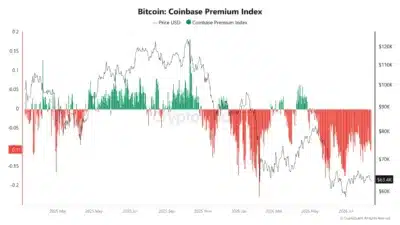
Source: CryptoQuant
Positive premium readings appeared more frequently during Bitcoin’s advance toward considerably higher prices during portions of 2025. However, negative readings became dominant as Bitcoin weakened and moved toward its current trading region.
According to XWIN Japan, weak spot activity alongside relatively heavy futures positioning creates an unfavorable market imbalance. Leveraged longs could unwind when supportive economic developments fail to generate enough spot buying for sustained price gains. Consequently, derivatives activity could increase selling pressure if traders reduce leveraged exposure during unsuccessful recovery attempts.
Bitcoin Faces $68,700 Short-Term Holder Barrier
Another important level sits near $68,700, representing the Short-Term Holder Cost Basis highlighted by XWIN Japan. Recent buyers could sell around that region as underwater positions approach their average acquisition prices.
Hence, Bitcoin needs stronger ETF inflows, positive Coinbase premiums, and improved spot volume to establish healthier demand conditions. Recovering $68,700 could also reduce pressure from short-term holders seeking exits around their acquisition levels.
In conclusion, Bitcoin’s muted inflation response highlights weak spot demand despite supportive macroeconomic conditions. Negative Coinbase premiums and the $68,700 barrier remain important obstacles for recovery.
Also Read: XRP Whales Scoop Up 72 Million Tokens as Holdings Jump Toward 12.18 Billion
